.svg "wisetack financing") NEW! We offer financing. Prequalify today and contact us to learn more about financing your next project!
NEW! We offer financing. Prequalify today and contact us to learn more about financing your next project!
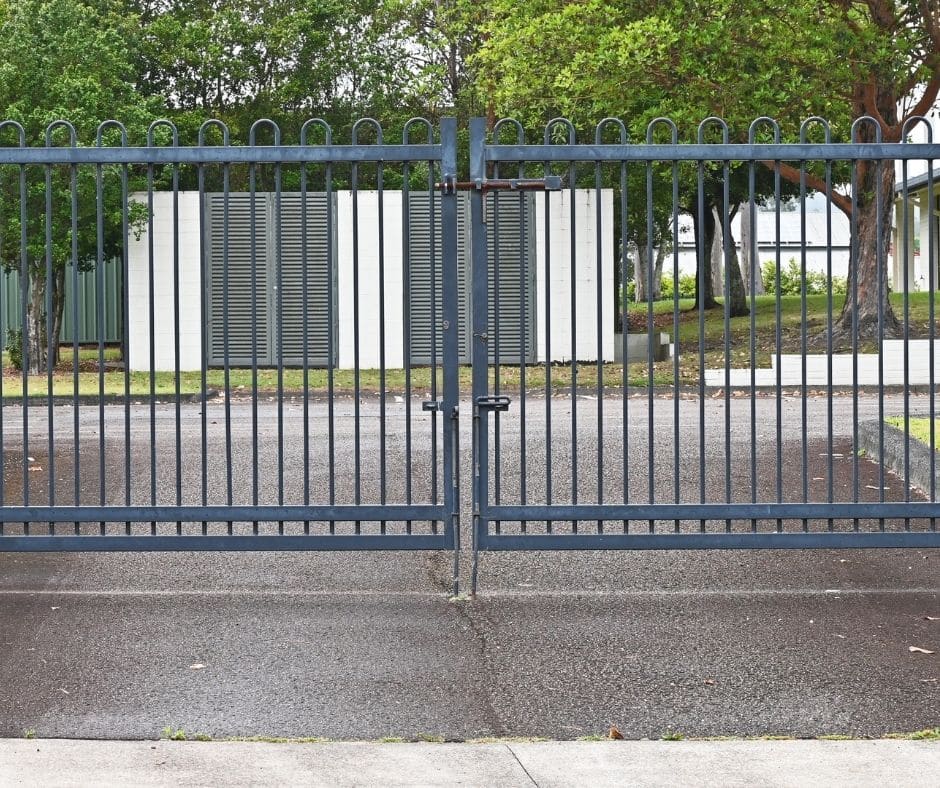
Commercial Gate Installation in Durham, NC: What Property Owners and Managers Should Know
A commercial gate is the one piece of your property that every employee, delivery driver, customer, and contractor interacts with — often several times a day. When it works, nobody thinks about it. When it fails, it blocks your entrance and your operation stops.
That’s why commercial gate installation deserves more planning than most people give it. The gate itself is only part of the decision. The operator, the access control, and the safety hardware all have to work together, and the right combination depends on how your site is actually used.
Here’s how to think it through:
- Traffic volume and vehicle type drive nearly every other choice
- Gate style — swing, slide, or cantilever — depends on your space
- Operator selection determines whether the gate lasts five years or twenty
- Safety code compliance isn’t optional, and it’s frequently missed
H3: Start With How the Gate Will Actually Be Used
Before anyone talks about materials or motors, answer these:
- How many cycles per day? A gate opening 15 times looks nothing like one opening 300 times.
- What’s coming through? Passenger cars, box trucks, and tractor-trailers need very different widths and turning room.
- Who needs access, and when? Employees only, or vendors and the public too?
- What happens in a power outage? Some sites need fail-open, others need fail-secure. Fire access requirements may decide this for you.
- How much room do you have? This is usually what rules out a gate type.
Get these answers on paper first. Every spec that follows depends on them.
H3: Swing, Slide, or Cantilever — Choosing the Right Gate Type
Three configurations cover most commercial sites, and space is normally the deciding factor.
- Swing gates pivot open like a door. They’re the simplest and most economical option, and they suit lower-traffic entrances well. They need clear arc space, and wide openings usually call for a double-swing setup.
- Slide gates run along a track across the opening. They’re the right answer when you don’t have room to swing, and they handle wide entries. The track does need to stay clear of debris and ice.
- Cantilever gates slide on a counterbalanced frame with no ground track at all. They cost more upfront but they’re the most reliable choice for heavy daily use and uneven ground, which is why you see them at industrial yards and distribution sites.
Material matters too. Chain link fencing is the workhorse for security and visibility, while ornamental fencing is the choice when the entrance is the first thing clients see. Your gate should match the commercial fencing around it.
H3: The Operator Matters as Much as the Gate
This is where most commercial gate installation projects go wrong. An undersized operator paired with a heavy gate will burn out, and replacing it costs far more than specifying it correctly the first time.
A properly matched operator accounts for:
- Gate weight and width, with real margin built in
- Duty cycle — light, medium, heavy, or continuous use
- Power available at the entrance, including whether solar makes sense for a remote gate
- Environmental exposure, which matters in our humidity and freeze-thaw swings
Operators are rated for a reason. Buying one class down to save money on install day is the most expensive decision in the whole project.
H3: Access Control — Who Gets In, and How
Once the gate moves, you have to decide who moves it. Common options include keypads, card and fob readers, telephone entry systems, loop detectors that sense a vehicle leaving, remote transmitters, and smartphone-based control.
Most sites end up combining two or three. Employees get fobs, visitors use a call box, and an exit loop lets anyone leave without a credential. If you’re weighing the technology side, our guide to smart gate features covers keypads and automatic openers in more detail.
H3: Safety Codes You Can’t Skip
Automated gates are powerful machinery, and there are standards governing them — UL 325 and ASTM F2200 being the two that matter most. A compliant installation includes entrapment protection sensors, proper guarding on rollers and pinch points, warning signage, and correct clearances.
Two reasons this matters beyond the obvious:
- Liability. A non-compliant gate that injures someone is an insurance problem you don’t want.
- Inspections. Fire marshals and local officials do check, and retrofitting is more expensive than doing it right.
Any contractor who waves this off is telling you something important about how they work.
H3: What Commercial Gate Installation Costs Depend On
Nobody can quote a commercial gate over the phone, and you should be skeptical of anyone who does. The real variables are:
- Opening width and gate type — cantilever costs more than swing, and wider costs more than narrower
- Operator class and whether you need battery backup or solar
- Access control complexity — a keypad is one thing, an integrated credential system is another
- Site conditions — grading, drainage, existing footings, and how far power has to run
- Material and finish
For fencing projects, our instant online quote tool gives you a starting number. Gate systems need a site visit, because the entrance conditions drive too much of the cost to estimate blind.
Plan for Maintenance Before You Install
A commercial gate is a mechanical system with moving parts under load, running outdoors, hundreds of times a week. Build service into the plan:
- Quarterly checks on hinges, rollers, tracks, and chain tension
- Annual testing of safety sensors and reversing mechanisms
- Keeping tracks clear on slide gates, especially after storms
- Knowing who to call, and how fast they can get there
Ask about response times before you sign. A gate stuck open is a security problem and a gate stuck closed is an operations problem.
Why Triangle Businesses Choose Dickerson Fencing
We’ve been fencing the Triangle since 1960, across three generations, and commercial work has been part of that from the beginning. Businesses here bring us everything from a single entrance gate to a full site package:
- Commercial gates and operators sized and installed to match real traffic
- Perimeter security fencing that works with the gate rather than around it
- Dumpster enclosures, guard rails, and partitions and enclosures
- Temporary construction fencing for sites still being built — see our construction fencing guide if that’s where you are
- Estate gates and openers for residential and mixed-use properties
We serve Durham, Raleigh, Chapel Hill, and the surrounding Triangle — check our full service areas to confirm we cover your site. You can also browse completed work in our project gallery.
Ready to Plan Your Commercial Gate Installation?
The best commercial gate installation is the one you stop noticing, because it opens every morning and closes every night without drama. Getting there means matching the gate, the operator, and the access control to how your property actually runs.
Call Dickerson Fencing at [phone_link] or request a free consultation online, and we’ll walk your entrance with you.